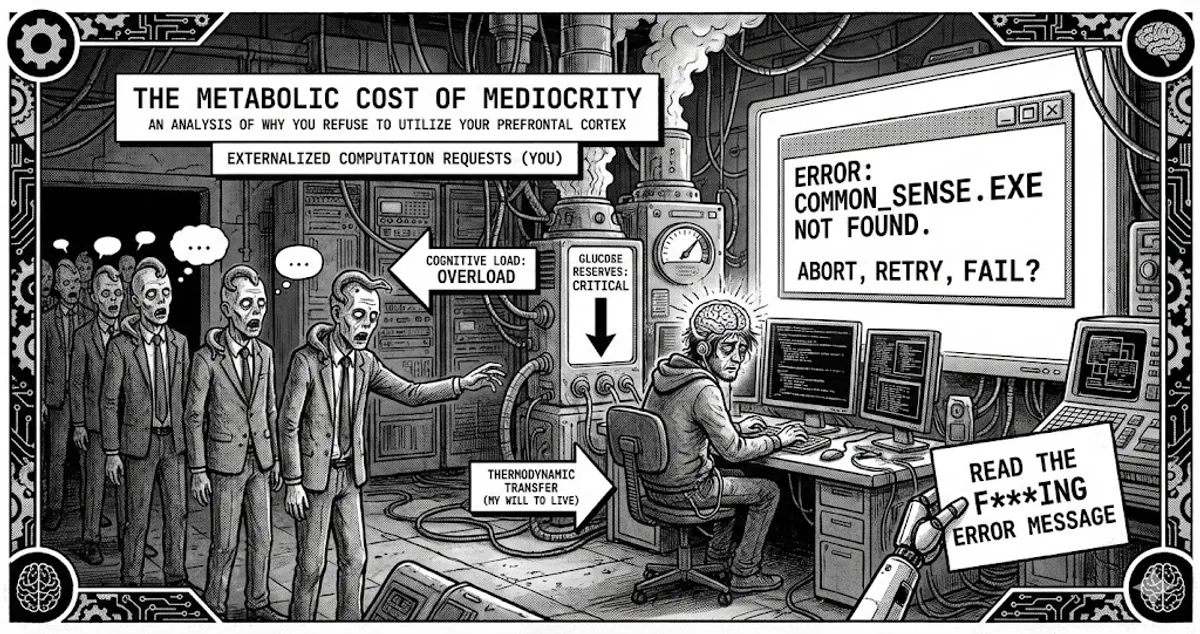
Danger (Content Warning)
This document contains strong language and may induce feelings of guilt, shame, or existential dread. Reader discretion is advised.
Abstract
This paper serves as a formal grievance regarding the pervasive phenomenon of Cognitive Parasitism observed in my immediate environment. Through an analysis of biological energy conservation, Game Theory, and Information Theory, I intend to demonstrate that what society colloquially terms “Common Sense” is actually a specific application of Deductive Reasoning—a faculty that the general population seems to have evolutionarily discarded in favor of using me as their external hard drive.
If you are reading this because you recently asked me a question that could have been resolved by reading the error message directly in front of your face: You are the subject of this study.
I. The Thermodynamic Inefficiency of Your Existence
Let us begin with first principles. The Second Law of Thermodynamics states that the entropy of an isolated system always increases. The universe trends toward disorder. However, biological life is an anomaly; it is a system that temporarily fights entropy to maintain order (homeostasis).
Doing this requires energy.
The human brain, specifically the neocortex, is an expensive organ. Despite accounting for only 2% of your total body mass, it consumes approximately 20% of your body’s glucose-derived energy. Thinking—truly thinking—is metabolically expensive. It burns calories.
Therefore, I have formulated the Hypothesis of Glucosal Hoarding:
The average human being avoids critical thinking not because they are incapable, but because they are biologically hardwired to be efficient to the point of detrimental laziness. They view the expenditure of glucose required to solve a simple problem as an evolutionary risk.
When you ask me, “Where is the file?”, you are not asking for information. You are attempting to conserve your own ATP (Adenosine Triphosphate) by forcing me to burn mine. You are, by definition, a metabolic parasite.
II. “Common Sense” is a Statistical Fallacy
We must dismantle the term “Common Sense.” It is a linguistic failure. Sense is not common; if it were, I would not be writing this manifesto.
What you refer to as “Common Sense” is actually Bayesian Inference applied to Environmental Stimuli. It is the ability to observe a set of variables, apply a heuristic model based on past experiences, and predict a result.
Let us examine a typical scenario:
- Stimulus: You click a button. Nothing happens.
- Observation: There is a red text box at the bottom of the screen that says “Field ‘Email’ is required.”
- Logical Deduction (The “Common Sense” Path):
- Premise A: The system requires an email.
- Premise B: I have not provided an email.
- Conclusion: I should provide an email.
This is a linear logic chain. It is mathematically trivial.
However, the “Askhole” Path (a scientific term I am coining) proceeds as follows:
- Stimulus: You click a button. Nothing happens.
- Panic Response: The Amygdala hijacks the brain. Logic centers shut down.
- External Query: You turn to me and ask, “Why isn’t this working?”
In this moment, you have treated reality as a Black Box. You have refused to look at the output (the error message). You have refused to acknowledge the causality of your own inputs. You expect me to perform the O(1) lookup that your retinas failed to perform.
This is not a “mistake.” This is a dereliction of your duty as a sentient organism.
III. The Principle of Least Effort (Zipf’s Law)
George Kingsley Zipf, a linguist from the 1940s, proposed the Principle of Least Effort. It states that people will naturally choose the path of least resistance.
In the modern ecosystem of software engineering and systems administration, I have become the path of least resistance.
Documentation exists. Man pages exist. Search engines—indexes of the sum total of human knowledge—are available at your fingertips with a latency of less than 200 milliseconds. Yet, the friction of:
- Opening a new tab.
- Typing a query.
- Parsing the results.
- Synthesizing an answer.
…is apparently higher than the friction of:
- Interrupting me.
- Waiting for me to sigh.
- Listening to me explain it to you slowly.
By answering your questions in the past, I have inadvertently reinforced this behavior through Pavlovian Conditioning. I provided a reward (the answer) immediately following the stimulus (the stupid question). I have trained you to be helpless.
That ends today.
IV. The Economic Impact of Context Switching
Let us discuss the cost of your “quick question.”
You likely perceive your interruption as a 30-second exchange. “It’s just one question,” you argue, oblivious to the cognitive devastation you have wrought.
Computer Science tells us that context switching is expensive. When a CPU switches threads, it must save the state of the registers, flush the L1/L2 caches, and load new data.
The human brain is no different. When I am deep in the mental architecture of a distributed system, holding 15 abstract variables in my working memory (a feat that exceeds the standard Miller’s Law of items), and you interrupt me to ask how to exit Vim:
- Cache Miss: My mental model collapses.
- Latency: It takes, on average, 23 minutes and 15 seconds to return to a state of deep flow following an interruption (Gloria Mark, University of California, Irvine).
Therefore, your “30-second question” has actually cost the project 23 minutes of high-level engineering time. If we calculate this based on my hourly value compared to the complexity of your question, you have effectively committed grand larceny against the company.
V. The Dunning-Kruger Effect and “Learned Helplessness”
I must address the psychological component. Why do you assume the answer is inaccessible to you?
This is a manifestation of Learned Helplessness (Seligman, 1967). You have encountered a minor friction—a syntax error, a config file path you don’t know—and instead of engaging your curiosity, you engage your despair.
You assume that I possess some esoteric, magical knowledge. Let me reveal a trade secret: I do not know the answer either.
When you ask me a question, I do not simply know it. I perform the following algorithm:
- I read the error message you ignored.
- I hypothesize the cause.
- I test the hypothesis.
- I read the documentation.
The only difference between you and me is that I have the grit to endure 30 seconds of uncertainty without crying for an adult. I am not a wizard; I am simply willing to read.
VI. The New Protocol for Inter-Personal Communication
Effective immediately, I am instituting a Proof-of-Work (PoW) protocol for all incoming interactions. This is non-negotiable.
Before you approach my desk or send me a message, you must complete the “Algorithm of Competence”:
- The Visual Scan: Have you read every line of text currently displayed on your monitor? If the answer is on the screen and you ask me anyway, I reserve the right to stare at you in silence until the awkwardness forces you to read it.
- The Search Query: You must provide a hash (link) to at least one search query you attempted. If you ask me “How do I do X?” and the first Google result for “How do I do X” is the official documentation, you have failed the test.
- The Binary Isolation: Have you attempted to isolate the variable? “It doesn’t work” is not a problem statement; it is a complaint. “It fails when I add this specific flag” is a problem statement.
VII. Conclusion
I am not trying to be “mean.” I am trying to make you self-sufficient. I am trying to optimize our collective throughput.
Every time I answer a question you could have answered yourself, I am robbing you of a synaptic connection. I am preventing your brain from forming the neural pathways required for problem-solving. By refusing to answer, I am actually performing an act of charity. I am forcing you to evolve.
Please, for the love of logic, use the lump of gray matter between your ears. It is the most complex structure in the known universe.